Teaching students to read a stand like a forester, decide what to do with it, and test that decision against a future that will not look like the past.
Foresters have always had to decide today what a stand will look like in eighty years. For most of the history of silviculture, experience was a good enough guide: the climate those trees would grow in resembled the one their predecessors had known. That is no longer true, and it changes what students need to learn.
My teaching sits on that seam. I start from traditional silviculture — stand structure, competition, tree selection, the forester’s eye in the field — and bring in dynamic models as one more instrument in the forester’s toolbox, not a replacement for it. Students leave able to do both: read a stand, and question what a model says about its future.
How I teach
See the stand
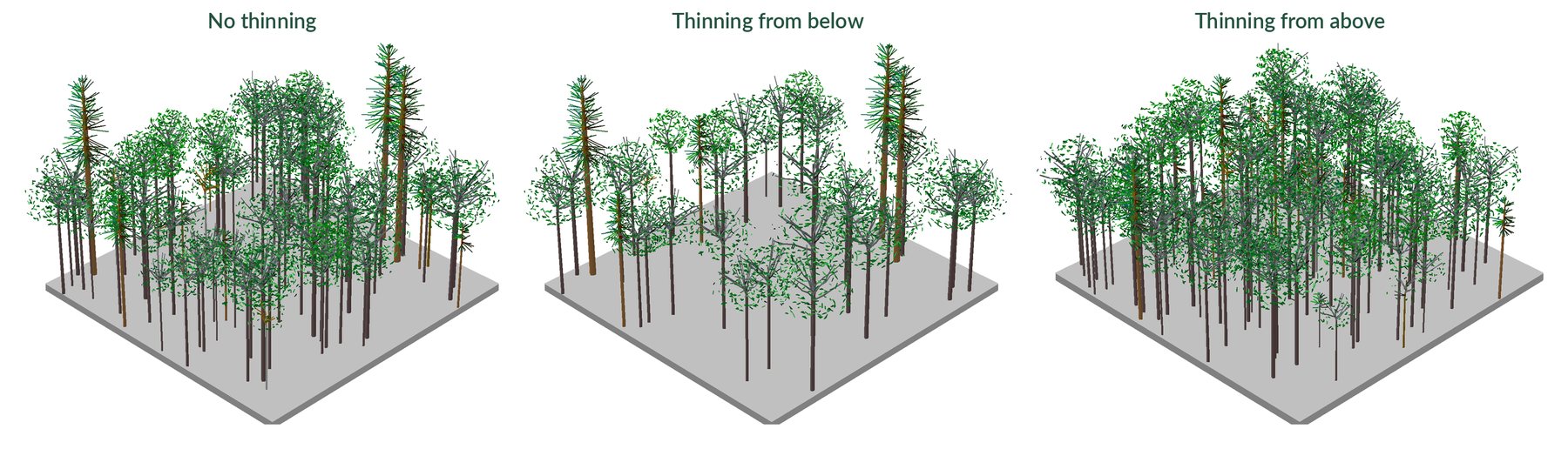
With the Stand Visualization System (SVS), inventory tables become three-dimensional
stands. Students draw the same forest before and after an intervention and learn to read
layering, crown space and gaps — before a single simulation runs.
Mark the trees
Marteloscope exercises put students in the forester's boots: which trees stay, which go,
and why. Their selection decisions are then translated into explicit rules a model can
follow.
Let time pass
The marked stand is grown decades ahead with a forest gap model, comparing growth,
mortality, regeneration, timber, carbon and risk across silvicultural strategies and
climates.
Argue with the model
When projections and field intuition disagree, that is the lesson. Students learn when to
trust a model, when to challenge it, and how to explain the difference to a practitioner.
The same 0.25-ha stand fifty years on, left unthinned or thinned from below or from
above (a quarter of the basal area removed at years 0 and 25). Simulated with an empirical stand
simulator in the Quantitative Vegetation Dynamics lab and drawn with the Stand Visualization
System.
Courses
2026 — present
Quantitative Vegetation Dynamics: Models from Tree to Globe MSc
ETH Zurich, D‑USYS · Lecturer · Autumn semester
From single trees measured in forest inventories to stand competition,
landscape disturbances and global vegetation — taught from the forester's side of the table:
what each kind of model can tell a manager about a real stand, and where it stops being
useful.
Students designed their own stand-scale experiments with ForClim and
interpreted the results in ecological and silvicultural terms.
2022 — 2023
Gebirgswaldökologie und Management MSc
ETH Zurich, D‑USYS · Laboratory and teaching material
A laboratory on mountain-forest dynamics and management, with a week of
teaching-material preparation each year, together with Alexander Carrella and
Prof. Harald Bugmann.
2018 — 2019
Best practices in forest operations to minimise erosion and soil compaction BSc
Guest lecture, Forest Pedology, University of Naples Federico II · Prof. Fabio Terribile
2018 — 2019
R for geospatial analyses MSc
Crash course, Geography and Soil Evaluation, University of Naples Federico II · five lessons
Outside the lecture hall
2021 — present
Public forest walks (Waldumgänge)
Benken ZH, with the district forester
Explaining silviculture and forest change to the people who walk in
these forests every day.
2023 — 2024
ForClim-Marteloscope training
ETH Zurich · students and practitioners
Tree-marking exercises confronted with simulated stand development, for
students and forest practitioners alike.
2016 — 2017
PRO.PRO.FOR. — seminar series and summer school
University of Padua · designed, funded and organised
Open seminars and a field school on silvicultural planning, forest
operations, environmental assessment, monitoring and precision forestry, to bring students
closer to the forestry profession.
Student support & mental health
Academic life can be hard, and it often pushes us to our limits and into dark places. Alongside teaching, I regularly support students and early-career researchers who are struggling — with the pressure of academic life, but also with bullying, difficult supervision, harassment and racism. I listen, offer advice and practical support, and help people find the offices and authorities that can help them further.
To do this well, I trained, and am still training, as part of a coaching group of the Foster. Lead. Promote. (FLP) programme at ETH Zurich, with coach Dr. Lille Springall. In these conversations I follow the principles of Nonviolent Communication, as described by Marshall B. Rosenberg in Nonviolent Communication: A Language of Life.
If you are experiencing problems too, please know that you are not alone. I also know some of these struggles from the inside. I grew up in the suburbs of a big city, in a family with no academic background, where nobody had been to high school, let alone university. I worked to pay for my studies, and I became a mother at the end of my PhD. As a young scientist and a parent, I can relate, understand, and offer free support and guidance.
There is a solution to every problem, and there are nice communities and villages you can join. Just write me an email and we can grab a coffee and chat!
Parents Network at WSL. I founded the Parents Network at WSL, which I now run
together with Dr. Christian Temperli (Swiss National Forest Inventory). We meet once a month.
If you are a parent at WSL, come and join our activities:
sign up here.
Theses supervised
2024
Raphael Schmid BSc
BSc Environmental Sciences, ETH Zurich · Co-supervisor
Waldsukzession nach einem Waldbrand in den Schweizer Zentralalpen.
Main supervisor: Prof. Dr. Harald Bugmann.
2021
Alessandro Aquino MSc
MSc Forest Sciences, University of Naples Federico II · Co-supervisor
Caratterizzazione dei suoli al limite del bosco: proprietà emergenti
nelle treeline di Fagus sylvatica dell'Appennino Centro-Meridionale.
Main supervisor: Prof. Fabio Terribile.
Theses supported
Students whose modelling work I helped set up, debug and interpret.
2024 — 2025
Livia Gysel MSc
MSc Environmental Sciences, ETH Zurich
Veränderungen der Struktur und Dynamik von Naturwaldreservaten unter
Klimawandeleffekten. Main supervisor: Dr. Mathieu Levesque; with Prof. Dr. Harald Bugmann
and Dr. Ulrike Hiltner.
2023
Francesca Eccher MSc
MSc Environmental Management of Mountain Areas, Free University of Bolzano
Forest stand modelling in drought-prone forests of South Tyrol.
Main supervisor: Dr. Marco Mina, Eurac Research.
2023
Lara Wüthrich BSc
BSc Environmental Sciences, ETH Zurich
Modelling support. Main supervisor: Prof. Dr. Harald Bugmann.
2022 — 2023
Laurin Hillebrand MSc
MSc, University of Innsbruck
Assessing the protective function of South Tyrolean forests under
future climate change. Main supervisor: Dr. Marco Mina, Eurac Research.
2022
Samuel Zweifel BSc
BSc Environmental Sciences, ETH Zurich
Analyses of tree regeneration after windthrow in a central Swiss
forest: testing a forest succession model's abilities. Main supervisor: Dr. Ulrike Hiltner;
co-supervisor: Dr. Mathieu Levesque.
Prospective students. If you are interested in a thesis on silviculture under
climate change, drought and tree mortality, or management scenarios for Swiss forests, feel free
to get in touch.